


production Strider 24

plywood Romany 34

lightweight 14ft Zeta mainhull

Strike 15 trimaran at speed

28ft Skoota in British Columbia

10ft 2 sheet ply Duo dinghy
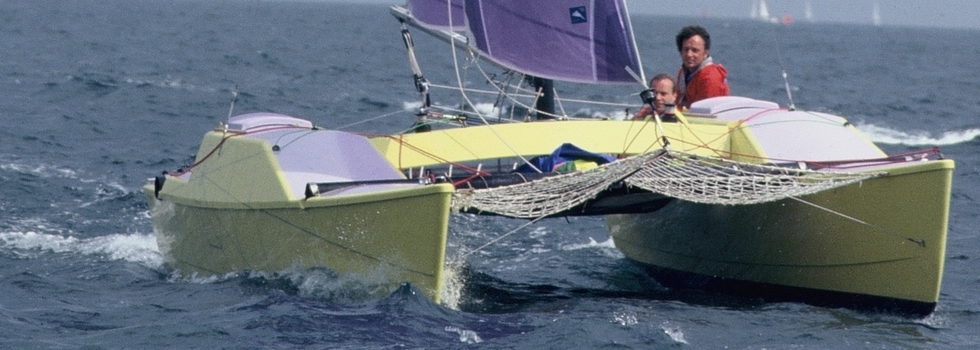
24ft Strider sailing fast

36ft Mirage open deck catamaran
Sagitta racing spring 2026
The 30ft Sagitta catamaran was designed as a performance cruiser, or cruiser/racer if you prefer. So throughout it's 34 year life we have raced it, while it's also been cruised far and wide (currently the furthest it's sailed was to Trieste in Italy)
Despite some terrible weather so far this year we have already had several short cruises and also had success in a few coastal races.
The first of these was the "Falmouth Triangle" race, the traditional season opener in Plymouth. We first raced it 40 years ago in our Banshee catamaran when we were the fastest multihull and beat all but one monohull round the course. But times move on and Sagitta is now almost the slowest MOCRA rated multihull. Many local boats are 40% faster, which means we rarely see them after the race starts.

This years triangle was no exception. There were 14 multihull entries, about a 1/3rd of the fleet, the first leg is roughly 40 miles - from Plymouth to Falmouth. Even under spinnaker and with 4 experienced crew on board, we soon dropped back, with the leaders out of sight ahead. Actually, since it was a misty day that turned to heavy rain for the last 3 hours, that wasn't surprising! Had we been cruising I'm sure we'd have all sat inside and sailed under autopilot. But as it was we got very wet and a bit bored sailing all alone in the murk.

So imagine our surprise, as we neared Falmouth, to see more and more boats appearing only just ahead! Some should have finished literally hours earlier, so not unexpectedly, when we arrived we learnt we had won the first leg on handicap.

Sadly that success wasn't repeated on the next two legs. The race to Fowey, about 20 miles east of Falmouth, was mainly a light wind beat, but unfortunately we were unable to use our masthead screecher due to halyard problems. So we finished 5th. Once in Fowey Peter went up the mast to, temporarily, sort it out. As he's only 25 he doesn't really need a bosun chair - he just monkeys up the forestay. Which sure makes it easier for the winching crew!

By now the sun had come out and we had another light wind beat back to Plymouth. We made a real lash up of twin barber-haulers for the screecher, but we now know how to set it properly. Even so, it wasn't too successful, another 5th, mainly because we couldn't really agree on tactics and in the end made too many compromises. So we came third overall.


A couple of weeks later Shane and I had another weekend race, this time the 20 miles to Fowey on Saturday and back to Plymouth on Sunday. Fewer boats this time, 8 multihulls and 25 half-boats. The conditions at the start in Plymouth couldn't have been more different from the previous race! Not a breath of wind, not a cloud in the sky and hot!

Multihulls "started" first, but most didn't actually sail, rather they drifted over the line. In fact the last multihull to start took 15 minutes to cross the line. We were one of the 4 lucky ones who got a gust just at the right time, so we were able to pull a mile or so ahead of the fleet within the first 20 minutes. Which certainly proves that calms can be a slow boat benefit! As we passed the breakwater a light WSW wind picked up, so it was then a beat to Fowey.

Unfortunately there was just too much wind for our screecher, but not really enough for the genoa alone. Although the trimarans went out to sea, we decided to compromise and kept further inshore, but even so, well to seaward of the monohull fleet. It didn't really pay off - the out to sea route was the best, but we didn't realise that until too late. Still, we were pretty happy with our 3rd place. Anchoring is no longer allowed in Fowey, so we all rafted up on some of the smaller pontoons and dinghied ashore for a meal.

Next morning the wind had increased to 12-15 knots and we prepared for a fast, downwind sail back to Plymouth - for once conditions that would favour Sagitta. Having said that, we weren't quite fast enough in those conditions to "hot it up" and gybe downwind as the others did. Instead we used "tweaker" lines on our asymmetric so we could pull the tack to windward and sail with the wind further aft. It certainly paid off for us compared to the others who, although faster, sailed further, so the whole multihull fleet stayed in sight for much of the race. Mind you, with only two on board we found gybing quite a challenge - more practice definitely needed!
So for the first 20 miles it was a no fuss, no frustration, no drama race. But that changed as we headed into the Sound and past the breakwater. Plymouth is not just the biggest naval port in Europe but also has very busy commercial docks. So it wasn't a great surprise to see a Portuguese warship leaving port as we were sailing in. They were probably not expecting to see an armada of 30 yachts under spinnaker spread across the channel! The escorting police boats started "blue lighting" and hailing the yachts to try and get them to gybe away. Luckily we were just far enough ahead to keep clear without a major course change.

To compound the problem the ferry from France came into port at exactly the same time. They had to wait in the middle of the Sound until not only the first warship cleared the main shipping channel, but also the second one, this time from Norway. Fortunately only one yacht ended up head to wind with spinnaker flapping while trying to avoid all three ships.
Hissy Fit and Gordano Goose are both 40% faster than Sagitta, yet were less than 30 minutes ahead of us at the finish, as the results show. On corrected time we had a 3rd and a 2nd. All in all, not bad results for a "proper" cruising boat. After all, we were the first boat carrying a dinghy in davits, BBQ and central heating!


You can see a short video of the Falmouth triangle here 30ft Sagitta catamaran in Falmouth triangle race 2026
and the race to Fowey here 30ft Sagitta catamaran in the Plymouth to Fowey race May 2026 - YouTube