


production Strider 24

plywood Romany 34

lightweight 14ft Zeta mainhull

Strike 15 trimaran at speed

28ft Skoota in British Columbia

10ft 2 sheet ply Duo dinghy
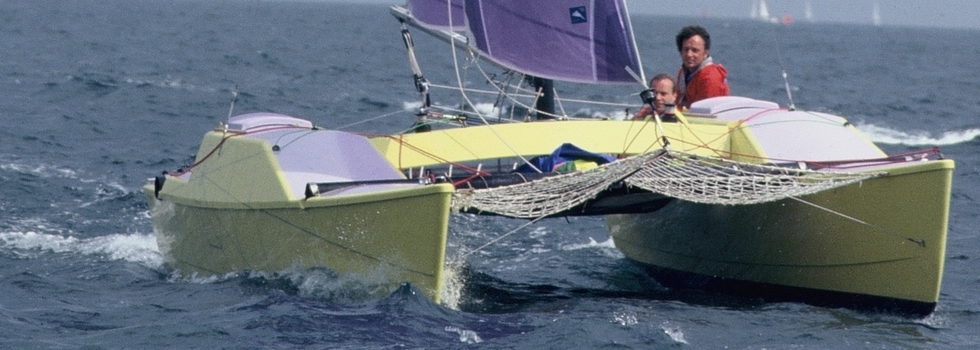
24ft Strider sailing fast

36ft Mirage open deck catamaran
Round the Island race 2026
The Island SC has been running the annual "Round the Island" race for over 90 years. It is a hugely popular race, over 800 boats this year; indeed it's a huge sporting event, the 4th largest in the UK (after the London marathon etc)
The race is nominally 50 miles, sailing anticlockwise round the Isle of Wight, but of course boats usually sail a minimum of 60 miles and always have both upwind and downwind legs. Although the start is timed for high water, thus ensuring a with-the-tide first leg, most boats then have to fight the strong tides for the next 40 miles. "Unfortunately" for competitors high water is always early - we had to get up at 4.45am to be ready for a 7am start.

I have now done the race 9 times, on various multihulls, the first time in 1981, and have come first or second in class on seven occasions. But the weather is always different and I don't do it every year, and never with the same crew. So there's always a steep learning curve.
This year I raced Sagitta with fellow club member and dinghy sailor Mark Tinkler, Henry Steele - the youngest on board, who ran the foredeck, and local expert Joe Moore (who raced with me in 2023). So an experienced crew, although we had never sailed together as a team.
For once it was a running start, so timing was crucial with the strong ebbing tide. As always, slower boats start near the island shore to get the best tidal push. We made a good start, staying on starboard gybe until we got clear, and were in company with the J70 sportboats who also start with multihulls.

We kept in the main tide while trying to avoid being blanketed by faster boats behind and were happy with our position at Hurst, marking the entrance to the Solent. We were still with the J70s and ahead of many nominally faster multihulls - indeed we were only 20 minutes behind Uno, the leading racing multihull.

Rounding the iconic Needles is challenging, as there is not only an unmarked wreck, but also Goose Rock lurks just below the surface. Having said that, a close rounding is essential - even with Joe on board we followed a deeper drafted boat just to make sure we avoided the dangers.

After rounding the Needles boats are faced with the near 500ft high Tennyson Down and its big wind shadow. Again, by following the boats ahead, we could see where the best wind was, so we didn't slow as much as others.
A long, into the blinding sun, close hauled tack followed, to St Catherines. Many boats sagged off down to lee, whereas we tried to get as close to the shore as possible - always aiming for the "notch" of the headland and out of the tide and, hopefully, into the back eddy.
As we approached the corner the gusts got stronger and I though about reefing, but Joe said "its always like this in an easterly, it will drop the other side" and indeed it did.

There then followed the most stressful and hardest part of the race. The five mile beat against a strong tide to Ventnor in company with, by now, hundreds of other boats all trying to keep as close to shore as possible.

Tack inshore on starboard to about 3.5m depth (Joe wanted us to go closer), tack out onto port. Repeat. Sometimes call for water, sometimes duck a starboard tacker. Repeat. And keep repeating - 51 times in five miles!

There was a major wind shift at Ventnor (something I've seen before) and somehow we came out of it better than most, The Dazcat Easy Tiger was ahead, then was suddenly well behind, for example. Another close fetch to Bembridge Ledge buoy gave us all a break and recovery time. Then spinnaker up for the final 12 mile run to the finish.

Only, this being the RtheI there is a catch. Ryde Sands. Midway down the run and the final turning point. It always catches some (including myself years ago) for the water goes from 4m depth to 1m depth within a boat length - or even a boat width, as we found.
Fortunately for others, the boats aground showed the shallows, but, as we were all running under spinnaker, a grounding meant getting help from the two RNLI RIBs to get pulled off - although we did see one crewman getting off and trying to push his boat. We passed it in comfortably deep water only a few feet away.

And then finally, finally, after nearly 10 hours of racing in 31C (88F) heat, we crossed the finishing line at 16.43.43

We knew we had probably won the bridgedeck catamaran cruiser class, but the real surprise was to learn we had also won the prestigious Golden Miller trophy for the shortest corrected time of all the multihulls!

So a great result, thanks to crew Mark, Henry and Joe. Full results are here https://racing.islandsc.org.uk/results


The watermarked photos were taken by David Harding of Sailing Scenes, see here
https://www.sailingscenes.co.uk/-/galleries/regattas-and-racing-events/cruisers-larger-keelboats/round-the-island-race-2026 .
There are hundreds of photos of other boats - he didn't just photograph Sagitta - although as I write this 5% of the published photos of the race did feature Sagitta!